





28 Sep Conservation and restoration of the Endangered Dracaena ombet tree in Ethiopia
Conservation and restoration of the Endangered Dracaena ombet tree in the relic Desa’a dry Afromontane forest of northern Ethiopia
Partner: Adigrat University, Ethiopia
Years: 2020-2024 & 2025-2028
This project is implemented by Adigrat University. It aims at ensuring a sustainable conservation and restoration of Dracaena ombet (EN) and its degraded habitats in Ethiopia through enhancing awareness of stakeholders, improving livelihoods of the local community, and restoring degraded habitats. The proposed project activities are implemented in the relic Desa’a dry Afromontane forest, northern Ethiopia.
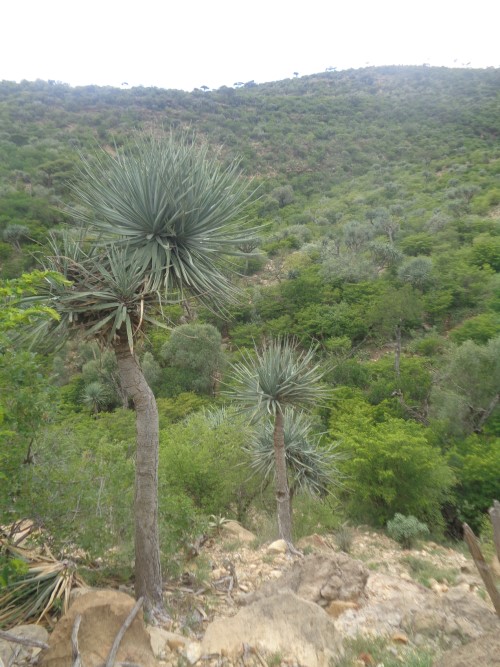
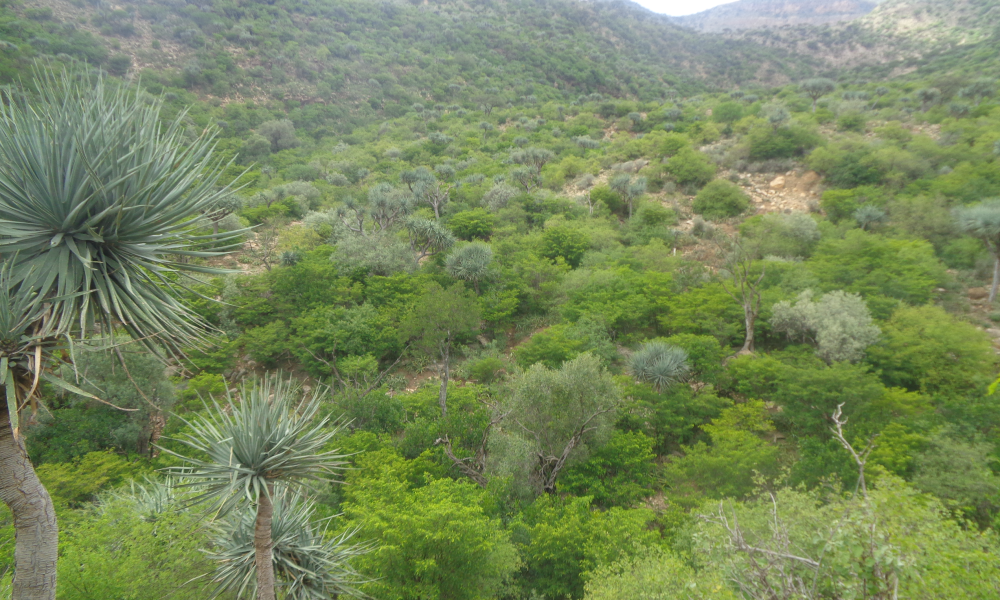
Dracaena ombet
Dracaena ombet is globally Endangered, and a flagship species of north-east African dry ecoregions. Previous research by Adigrat University showed that the species has been heavily threatened by overexploitation and habitat degradation. The first phase of the project, initiated in 2020, trained and educated 420 local stakeholders on the conservation of the species and improved the livelihoods of 40 local women, whose subsistence income were highly dependent on the overexploitation of the species, through poultry and beekeeping.
The project also improved natural regeneration and the growth of 3,640 mature Dracaena ombet trees by improving soil fertility while reducing soil erosion. The project planted 500 Dracaena ombet seedlings (of which about 90% survived) in their natural habitats.
With this new phase, Adigrat University is scaling up and expanding the abovementioned interventions for sustainable conservation and restoration of Dracaena ombet and seven other globally or nationally threatened trees in Desa’a, among which Senegalia venosa (EN), Combretum hartmannianum (VU), Combretum rochetianum (VU), Vachellia bavazzanoi (VU), Dobera glabra, Boswellia papyrifera and Dovyalis verrucosa.
This project’s expected outcomes include: 730 local stakeholders trained on the conservation of the target species, and 100 local women benefitting from improved income. 50 ha of degraded habitats of the species restored, and 4,000 more seedlings of Dracaena ombet and other globally threatened trees planted.